//
Recently I had the opportunity to attend a live broadcast of the talk given the former NBA Player Paul Shirley who is an Iowa State alumni and ESPN sports writer now.
In this short article I will shed some lights based on his discussion about globalization. Globalization at the end of the day definitely creates some sort of competition. Now the burning question is whether competition unite cultures or rather drive them apart.
It is indeed an interesting experience to see globalization through the eyes of a basketball player when Paul Shirley presented his real life experience.
Paul Shirley mentioned when he was in Greece, he noticed local basketball players listened to folklore music which he was not accustomed with. He did not seem to connect to that type of music. Many could interpret this as that his experience indicates that globalization driving apart the culture. I personally do not agree with this.
I do not think globalization drive the cultures apart. Paul Shirley in the above example just did not connect to that particular type of music. That does not mean that he did not learn anything about that culture or did not like anything about it at all. He many not even like some music here in US. For example he may not like country music (which I do not know. Let’s just hypothetically say this). That does not mean that he does not like American culture.
I do not think by no means he said that globalization drives the cultures apart.
He did learn about overseas cultures (Greece and Easter Europe) and he wrote many blogs while he was those places. He learned what the differences are between American culture and the cultures that he had experienced. There are many things he may have liked and there are many things that he did not. This tells me that there was intra-culture communication. I think when there is intra-culture communication, that is a sign of uniting them.
Cultures are dynamic and very contagious. One culture always tends to learn from others. Japan is a greatest example now. Many Japanese could be more western cultured than many of us in Iowa. Many of the Japanese have cell phones, iphones, ipods, xbox and other western icons. Many of them know who Chris Brown or Hannah Montana is. I can not say for guarantee that in Iowa everyone as westernized as some of the Japanese.
So far, I have not focused on the topic of competition. Global competition reduces monopoly and that eventually helps majority of the global citizens.
I will bring Paul Shirley’s basketball experience here again. If he did not compete overseas, he may have been unemployed in US. So, global competitions indeed helped him. On the other hand, if Greece did not have players like Paul Shirley, they may not have enhanced their own skills in basketball to the level where they are now today. So, players like Paul Shirley have helped the Greece and other overseas basketball as well. Thus, it is a win-win situation for all in this example.
Therefore, I can conclude that competition created by globalization tends to unite cultures, not drive them apart.
One of the audiences of the lecture, Lauren H. commented, “There is so much we can learn about each other, and ourselves, through globalization. Of course there is always the point where we hold on to our own culture. It could be because we are insecure in our cultural beliefs that we cling so tightly”.
Indeed that is mainly problem that we so tightly cling tightly our culture believes because there is tremendous fear; fear of unknown somehow takes over.
Another colleague of the audiences, Jenna R., responded to my perspective by saying, “I agree with your perspective that globalization does not drive cultures apart, but eventually unites cultures which previously may have not been understanding of what each other are about. However, I do believe that there are times when cultures may conflict with the globalization effect and one or both countries are negatively affected. For example, as Americans we could be misunderstanding of Middle Eastern culture and them of us, so what are we both losing from the unwillingness to understand each other? How does it affect other cultures of the world? I believe it causes dislike and forces cultures to essentially choose support teams to combat other cultures, thus the cultures repel each other rather than attempting to understand and losing out on another perspective”.
I like Jenna’s example as it is very relevant to current events. There is a huge gap between American and Middle Eastern cultures. Partly due to ignorance on both sides and unwillingness to understand each other and also partly due to politics of power and oil. Differences in cultures, religions and race can drive people apart but when globalization takes place, these differences tend to smooth out after initial confrontations. One example is American-German relationship. Today in US, the phrase “Middle Eastern” sounds similar to the word “Germans” in 1940s even though events are different and the magnitudes are different (this may not be the case in rest of the world). Hopefully meaning to these terms eventually not be too hostile as the globalization makes us the better global citizens.
Zack K. elaborates on my opinion, “Most of the time, there is ignorance on both sides, and each side tends to generalize and put every one in the same group. A lot of times, people just assume that if a person is from one country, that they are exactly the same as a select group that may have given that nation/religion a bad reputation.
Personally, my family has had several foreign exchange students when I was younger and those were nothing but great experiences for my family and also helped us gain a different perspective on other nationalities. I think the only reason people struggle to understand other cultures is that they are “bull-headed” and not willing to try and understand other cultures.
In terms of globalization and business, I think that if people would be open to other perspectives and be more reasoning, it would improve the economy and help advances in technology move along at a much faster rate”.
Zach hit on two key phrases, “Economy” and “advances in technology”, “I [Zach] think that if people would be open to other perspectives and be more reasoning, it would improve the economy and help advances in technology move along at a much faster rate.”
The world has changed a lot in the recent years. The challenges of the twenty first century are totally different from the previous centuries. We can not be content with what we have right now and be too egger to just cling on it. We have to figure out ways to improve it constantly. We have to figure out what are the ways to make better economic growth and advance the technology.
Technology is a mean to improve economic growth. Advancement in technology almost directly represents economic growth.
The acronym ‘BRIC’ refers to Brazil, Russia, India and China, four major emerging economic giants who are under pressure to perform right now. If they do not, these regimes will collapse economically and poverty will take over almost two third of the world. As their solution to their problems, they have embraced “globalization” and they are indeed doing well. Just because in US, we are doing relatively better than those countries, we can not afford to avoid embracing “globalization”. It almost sounds like regardless whether globalization unites or divides cultures, we have to embrace it and compete with BRIC without being under pressure like them. US got the advantage, the head start.
Usually there is initial cultural resentment, which eventually gets replaced by acceptance and appreciation.
I think the initial resentment is due to fear of unknown. Most of those Iowa farmers have not been exposed to the global influences like this before in their personal life. Once they learned about it, they have discovered how this globalization can help them. Thus this incident of globalization is uniting Iowa (American) culture and Australian culture.
Date: September 4, 2008
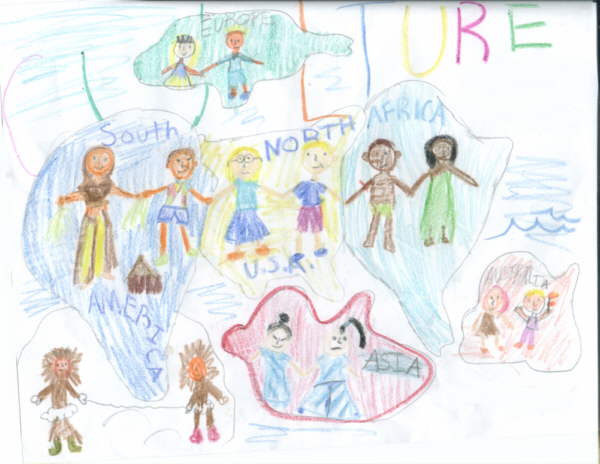
Source of the picture: [1] http://www.patterson-smith.net/images/culture.jpg



 Mirpur Square